
可能性を解き放つ:従業員におけるゲーミフィケーションの力
可能性を解き放つ:従業員のデータサイエンス学習におけるゲーミフィケーションの力
The project developed a data-driven framework for evaluating innovation ideas, with a focus on novelty and business value. It began with a broad challenge: use AI and advanced analytics to generate ideas, compare them against existing research, predict business value, and prioritize the strongest opportunities. The team quickly reframed the work from an idea generation problem into an idea evaluation problem. The core issue was not whether AI could produce more ideas, but whether those ideas were meaningfully new and worth pursuing.
To make evaluation possible, the team first created a structured way to describe ideas. They used a schema called PEMPSA, which breaks each idea into six fields: Problem, Environment, Mechanism, Physical Ingredients, Source Domain, and Applicability. This shared format made it possible to compare ideas by their underlying meaning rather than by surface-level wording. It also helped reveal when two ideas sounded different but were conceptually similar.
The project defined novelty as a form of distance from what already exists. Instead of treating “newness” as a vague judgment, the framework measured it across three dimensions: recombination distance, knowledge origin distance, and impact distance. These dimensions ask whether an idea combines components in a new way, whether it draws from distant knowledge domains, and whether it could shift future applications or value.
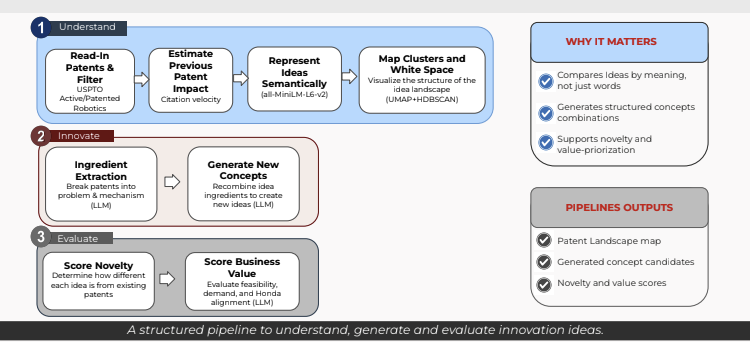
The methodology used patent data as the foundation for comparison. The team filtered robotics-related patents, extracted key idea components using language models, represented ideas semantically with embeddings, and mapped the patent landscape using clustering techniques. This allowed the system to compare ideas by meaning, identify dense areas of existing work, and surface white-space opportunities where fewer similar patents existed.
The framework also included a business value layer. Ideas were scored for feasibility, market demand, and strategic alignment. The result was a prioritization matrix that placed concepts along two axes: novelty and business value. This helped separate ideas that were both new and valuable from ideas that were familiar, impractical, or less strategically useful. One highlighted concept was pressure-sensory geofencing for autonomous machines, which scored highly on both novelty and business value.
Overall, the project showed how AI can support innovation strategy by turning unstructured research and patent data into structured, comparable, and prioritized opportunities. Its main contribution was not replacing human judgment, but giving teams a clearer starting point for it. The framework helps move R&D from subjective brainstorming toward more evidence-based white-space validation, while still recognizing that final decisions require expert review, engineering validation, and domain knowledge.
接続状態を維持
ミディアムとLinkedInで私たちの旅をフォローしてください。