
Multi-Agent Trend Intelligence with LLMs
Multi-Agent Trend Intelligence with LLMs
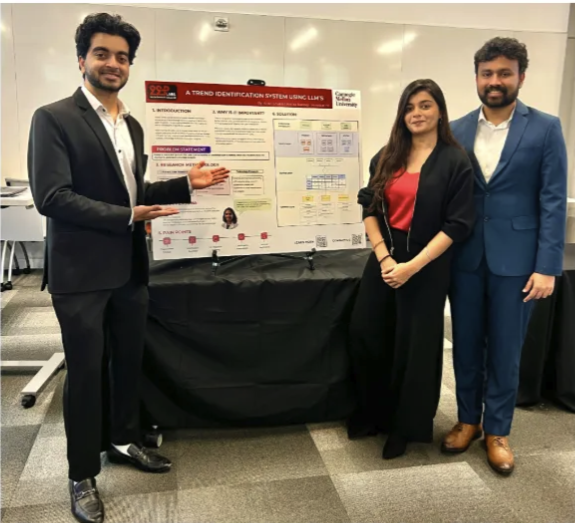
This capstone project, completed by CMU MSPM students, investigated how large language models can be organized into a multi-agent workflow to support systematic innovation trend analysis. The research focus was on moving beyond ad hoc, manual scanning of information by designing an approach that is repeatable, transparent, and suitable for ongoing use across multiple technology domains.
From a research perspective, the project began by characterizing the core limitations of current trend identification practices: signals are dispersed across heterogeneous sources, historical context is difficult to preserve, and verification is time-intensive. Through interviews and a review of existing analyst frameworks and LLM-based tools, the team identified that the bottleneck is not access to information, but reliable sensemaking: connecting weak signals into coherent patterns while minimizing noise and maintaining trust.
The central contribution is the Trend Identification Pyramid, a four-layer architecture that structures trend analysis into explicit stages. First, the system formalizes the scope and time horizon of inquiry. Second, it gathers signals across primary, secondary, and social sources to improve coverage and reduce bias from any single channel. Third, it evaluates candidate trends using a transparent scoring rubric based on credibility, frequency, recency, and relevance, enabling consistent comparisons across trends and time windows.
The research design emphasizes explainability and provenance as first-class outcomes. Rather than producing summaries alone, the system is intended to generate traceable, evidence-backed outputs where users can understand why a trend was surfaced, how it was prioritized, and which sources contributed most to its ranking. This framing treats trust as a measurable design requirement, addressed through explicit criteria, weighted scoring, and citation-backed synthesis.
Overall, the project explores a practical pathway for using agentic LLM systems as decision support for future-scouting and R&D strategy. It demonstrates how decomposition into specialized agents can help manage retrieval, evaluation, and synthesis at scale while preserving methodological rigor. The prototype serves as a foundation for future research into calibration of scoring weights by domain, longitudinal tracking of trend evolution, and evaluation methods that compare AI-supported trend outputs against expert analyst baselines.
Stay Connected
Follow our journey on Medium and LinkedIn.