
Transforming Slide Decks into Searchable Knowledge
Transforming Slide Decks into Searchable Knowledge
This project developed an AI-enabled approach for turning slide decks into accessible, searchable knowledge. The goal was to make information stored in presentations easier to retrieve and use, without requiring teams to manually comb through large collections of slides. The work focused on producing a practical solution that improves the reliability of answers compared with using a general-purpose chatbot alone.
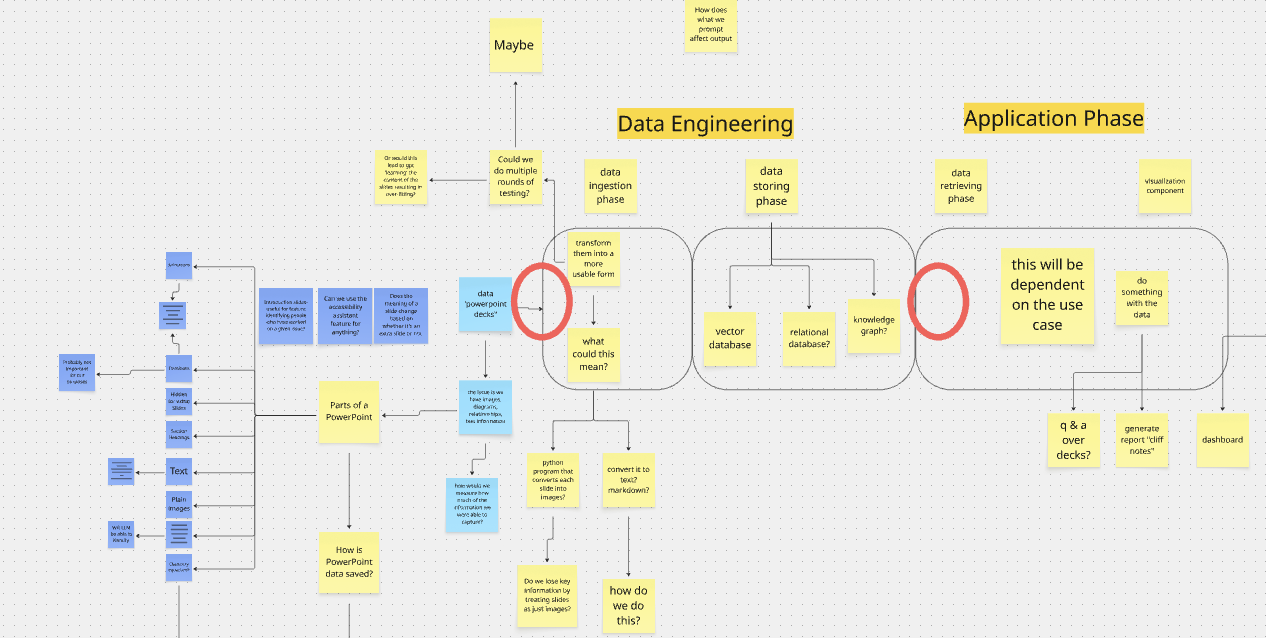
The solution follows a retrieval-augmented generation (RAG) design, which combines search with a language model. Instead of generating responses from memory, the system first finds the most relevant material from the slide content and then uses that material to form an answer. This structure is intended to improve accuracy, consistency, and user trust.
A key emphasis was translating slide content into a format that supports effective search. Presentations often contain fragmented text and meaning embedded in visuals, so the project converts slide information into standardized text representations that can be indexed. This enables semantic search across slides and supports answering questions in natural language.
The system is built to support interactive use, allowing users to ask questions and follow up in a conversational way. It maintains context across turns, helping users explore a topic iteratively rather than through one-off queries. The experience is designed to be lightweight and approachable for non-technical users in a prototyping or internal setting.
Overall, the project demonstrates a scalable pattern for unlocking organizational knowledge trapped in slide decks. It provides a foundation for expanding into more robust user interfaces, stronger reliability features, and broader coverage of presentation artifacts. The result is a practical step toward faster, easier access to institutional knowledge and improved decision support.
Stay Connected
Follow our journey on Medium and LinkedIn.