
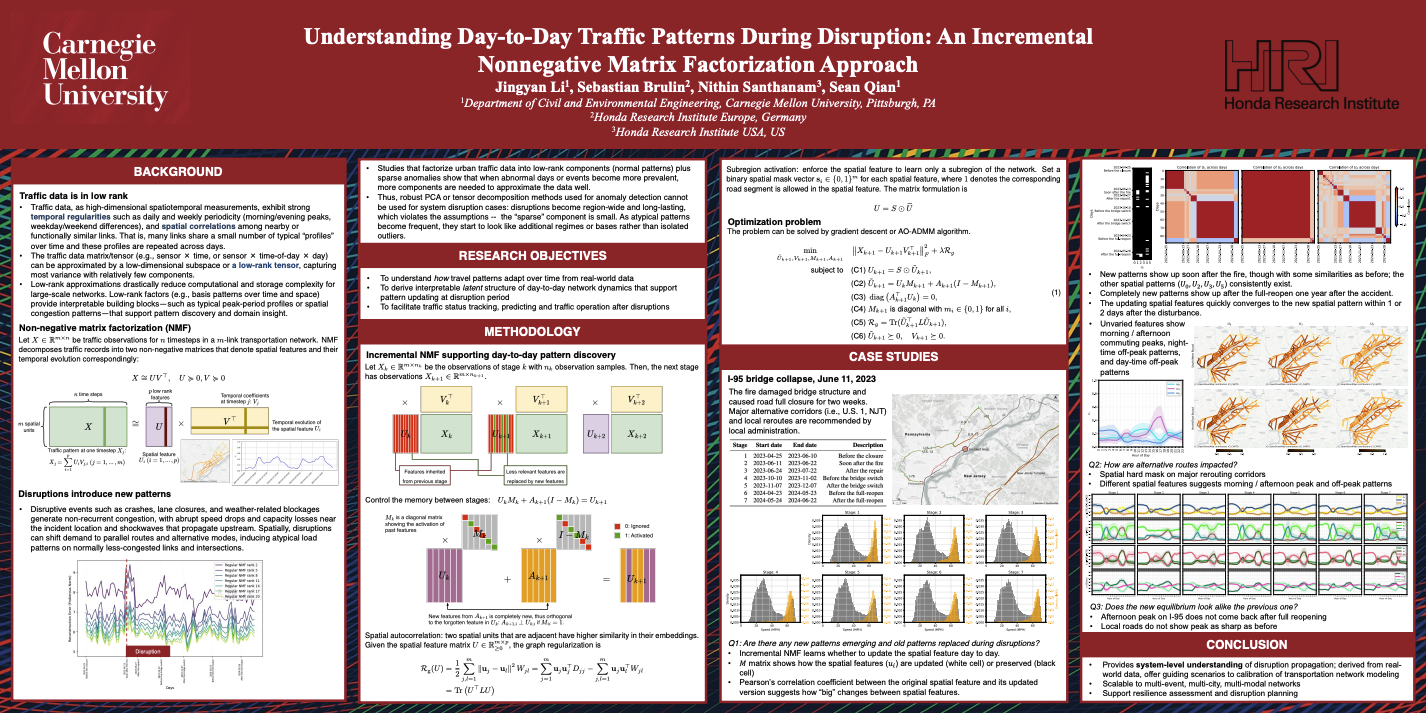
Understanding day-to-day traffic patterns during disruption: an incremental nonnegative matrix factorization approach
Background:
Road sensor data follows strong daily and weekly patterns, so a few typical profiles can describe most traffic. Major disruptions break these patterns across a whole region for weeks or months. Standard methods treat disruptions as rare outliers, so they fail in these cases. This project from Carnegie Mellon University and Honda Research Institute studies how traffic patterns change and recover after a disruption.
Methods:
The team developed an incremental nonnegative matrix factorization (NMF) method. It splits traffic data into spatial features (where traffic patterns occur) and their changes over time. At each stage, the model decides which features to keep and which to replace with new ones. It also keeps nearby road segments similar and can focus features on specific areas, such as detour routes. The method was tested on the June 2023 I-95 bridge collapse in Philadelphia.
Findings:
New traffic patterns appeared soon after the collapse, and the model adapted to them within 1 to 2 days. Commute and off-peak patterns elsewhere stayed stable. After full reopening, traffic did not return to its old state: the afternoon peak on I-95 never came back, and local roads had milder peaks than before. The method can scale to other cities and events and support disruption and resilience planning.
Learn more at: link
Stay Connected
Follow our journey on Medium and LinkedIn.