
Long-Horizon Traffic Forecasting via Incident-Aware Conformal Spatio-Temporal Transformers
Background:
Traffic changes hour to hour, and crashes, bad weather, and work zones cause sudden disruptions. Most forecastine models only look 15 to 60 minutes ahead and assume. the lnks between roads stay the same all day. Agencies need forecasitng several hours out, with reliable ranges showing how cnofident each forecast is. This project from The Ohio State University, the Ohio Department of Transportation, and Honda Research Institute USA forecasts traffic up to four hours ahead with calibrated uncertainty.
Methods:
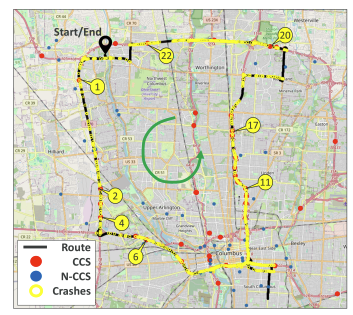
The team built a Spatio-Temporal Transformer that learns traffic patterns over time and across road sensors. Instead of one fixed road network, the model uses 24 hourly versions. Each one reflects how much travel times vary at that hour, with more spread during peaks. These networks are then adjusted using 2023 Ohio crash records, including clearance time, weather, speeding, work zones, and road type. A conformal prediction step adds a confidence range to every forecast. The method was tested on 2023 Ohio traffic data against nine other models and checked with multi-hour simulations of a 47.5-mile Columbus route.
Findings:
The model was the most accurate of all methods tested at every horizon from 1 to 4 hours, and its errors grew the slowest as forecasts reached further ahead. Its confidence ranges captured 91 to 94% of actual values while staying tight, about half as wide as standard conformal prediction at 2 to 4 hours. Crashes weakened the links between nearby stations, and this effect changed by hour. Simulated travel times matched the expected pattern, supporting the model's assumptions. The approach can scale to larger networks and support real-time traffic management.
Learn more at: link
Stay Connected
Follow our journey on Medium and LinkedIn.