
Hindsight: A Knowledge Graph Layer for Navigating Large Codebases
Hindsight: A Knowledge Graph Layer for Navigating Large Codebases
Hindsight investigates how AI systems can better understand large software repositories. Modern codebases are spread across many files, modules, functions, and dependencies, which makes it hard for both developers and language models to answer questions that require multi-file reasoning. The project starts from a clear research problem: most code assistants retrieve code through text similarity, but software behavior is shaped by structure, including imports, function calls, definitions, and cross-file relationships.
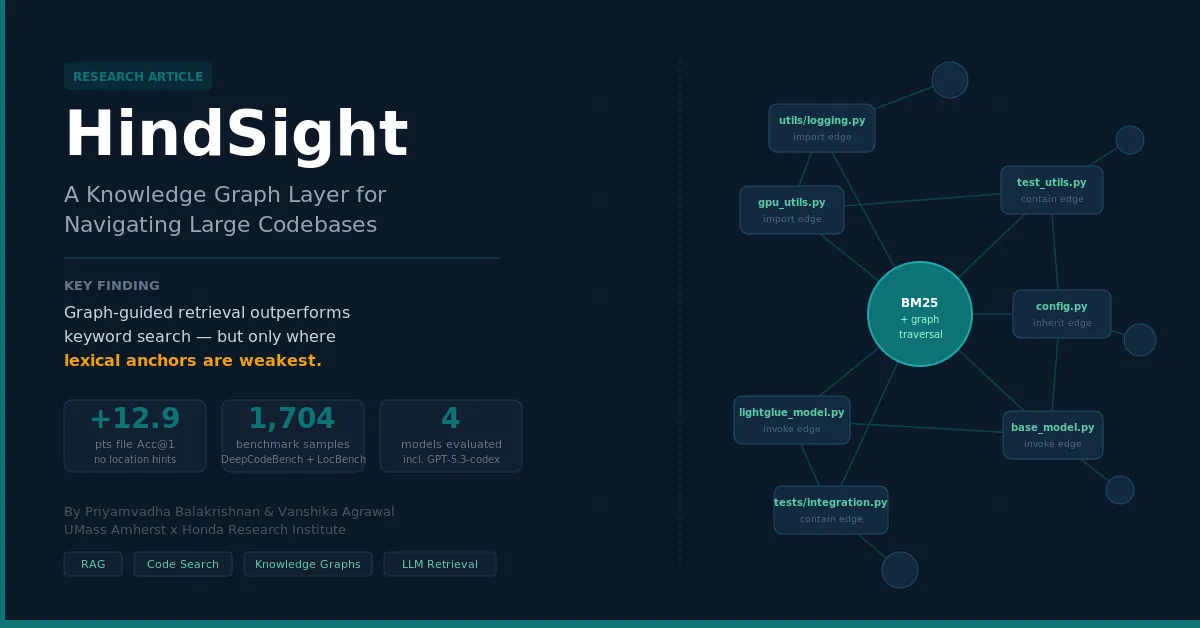
From a research perspective, the core question is whether graph representations of code repositories can improve retrieval-augmented generation for codebase understanding. Instead of treating a repository as a flat set of text chunks, Hindsight explores a hybrid approach. It begins with lexical retrieval, such as BM25, then expands context through repository graphs that capture structural relationships across the codebase. This lets the system surface files and functions that may not share obvious keywords with the user’s question but are connected through the program’s architecture.
The project evaluates this idea across realistic repository-level benchmarks. DeepCodeBench is used to measure answer generation for code questions, while LocBench is used to measure whether the system can locate the relevant files, modules, or functions. The team studies different query types, including exploratory questions about unfamiliar code, leading questions about planned changes, and lagging questions about debugging after failures. This framing makes the research more realistic because developers ask different kinds of questions at different stages of software work.
The results show a nuanced picture. Retrieval improves performance substantially over limited-context answering, confirming that repository evidence is essential for grounded code intelligence. BM25 remains a strong baseline, especially for deep, searchable questions with clear lexical anchors. Hindsight’s graph-guided approach is most promising on broad, cross-file questions and cases where location hints are weak or missing. In those settings, structural signals help identify relevant files that flat text search can miss.
The broader contribution of Hindsight is its view of code intelligence as a retrieval and localization problem, not just a model-generation problem. The project shows that better answers depend on finding the right repository context before asking a model to reason. Its findings point toward future systems that combine lexical search, code graphs, query intent, and reranking to help AI assistants navigate large codebases more like experienced developers do.
Stay Connected
Follow our journey on Medium and LinkedIn.